

Payment systems evolve when existing systems no longer support how people and businesses exchange value. With every generation, new infra emerged to solve the problems of the previous one. This resulted in money moving further, faster and more reliably, expanding how commerce operated.
The latest chapter in that evolution is cryptocurrency, which introduced how value could be transferred over a distributed blockchain ledger, without relying on a central intermediary. Bitcoin proved the concept, but it is too volatile for everyday payments.
Stablecoins solved that, combining the benefits of blockchain-based transfers with the price stability people need for real commerce. For the first time, it became possible to move digital dollars globally on a common blockchain settlement layer.
That possibility is now driving a broader transformation of the financial system. Around the world, companies, banks, payment providers, and governments are exploring different approaches to stablecoin-based payments and infrastructure. The shift is unfolding at different speeds in different forms, but the direction is becoming increasingly clearer.
The world’s financial plumbing is being rebuilt around a system that is more efficient, transparent, and, importantly, more beneficial to both consumers and businesses.
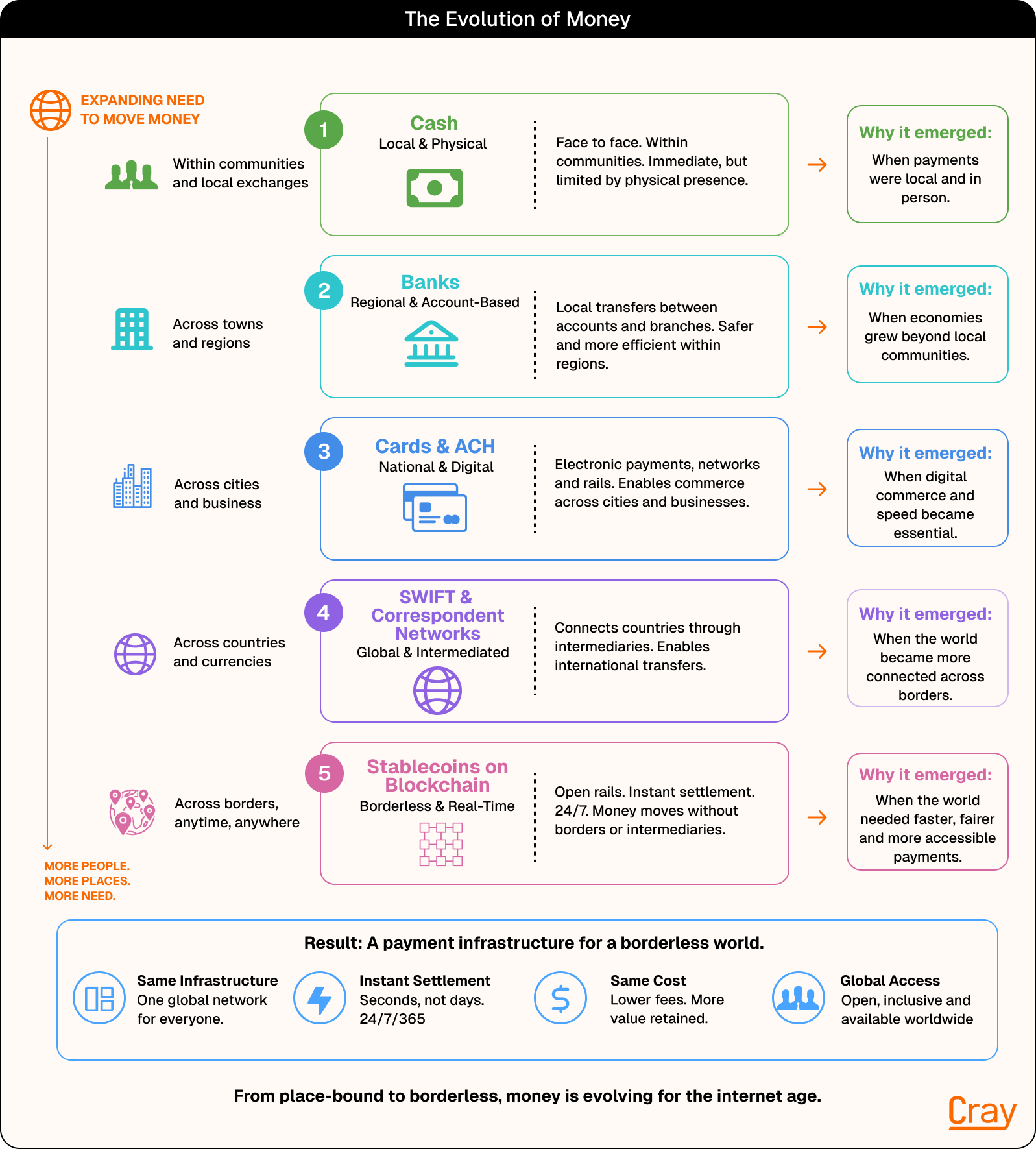
Below, we explore how traditional payment systems work, where they break for merchants and businesses, why stablecoins create a better alternate payment layer, and how the stablecoin payments ecosystem is taking shape in 2026 across infrastructure, applications, custody models, and regulations.
The opportunity is not simply faster checkout. It is the possibility of instant, global settlement on the same underlying infrastructure.
How Traditional(Current) Payment Systems Work
Buying a coffee feels simple: tap a card, scan a QR code, click checkout and walk away. But underneath, a payment is not one movement of money. It is a chain of authorisation, messaging, clearing, settlement, risk checks, reconciliation and dispute handling.
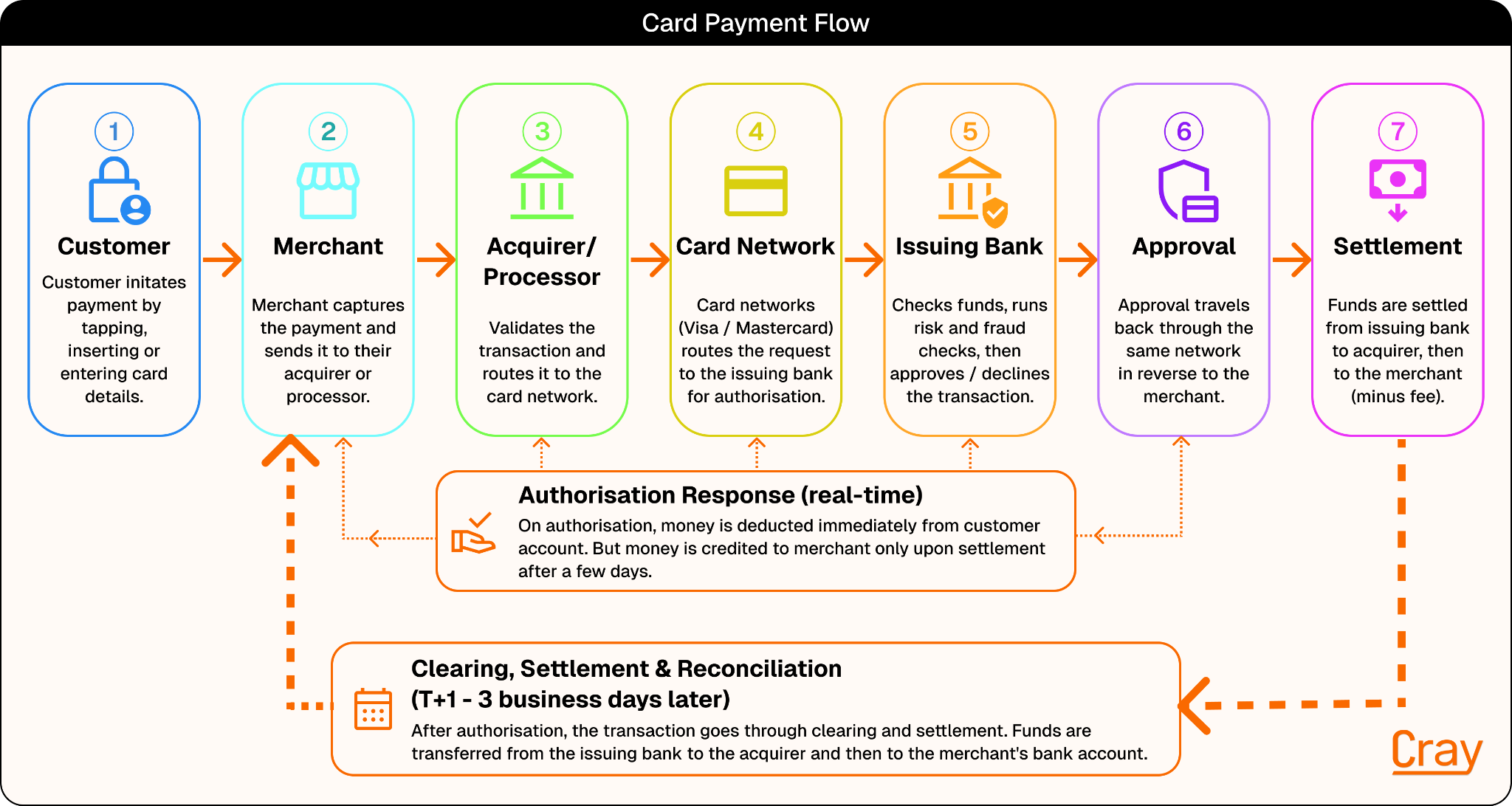
The payment request travels through this chain of various financial institutions before returning with an approval/decline. While the customer receives confirmation within seconds, the actual movement of money happens later.
Though payments feel simple to customers, it is expensive, slow and operationally complex for merchants.
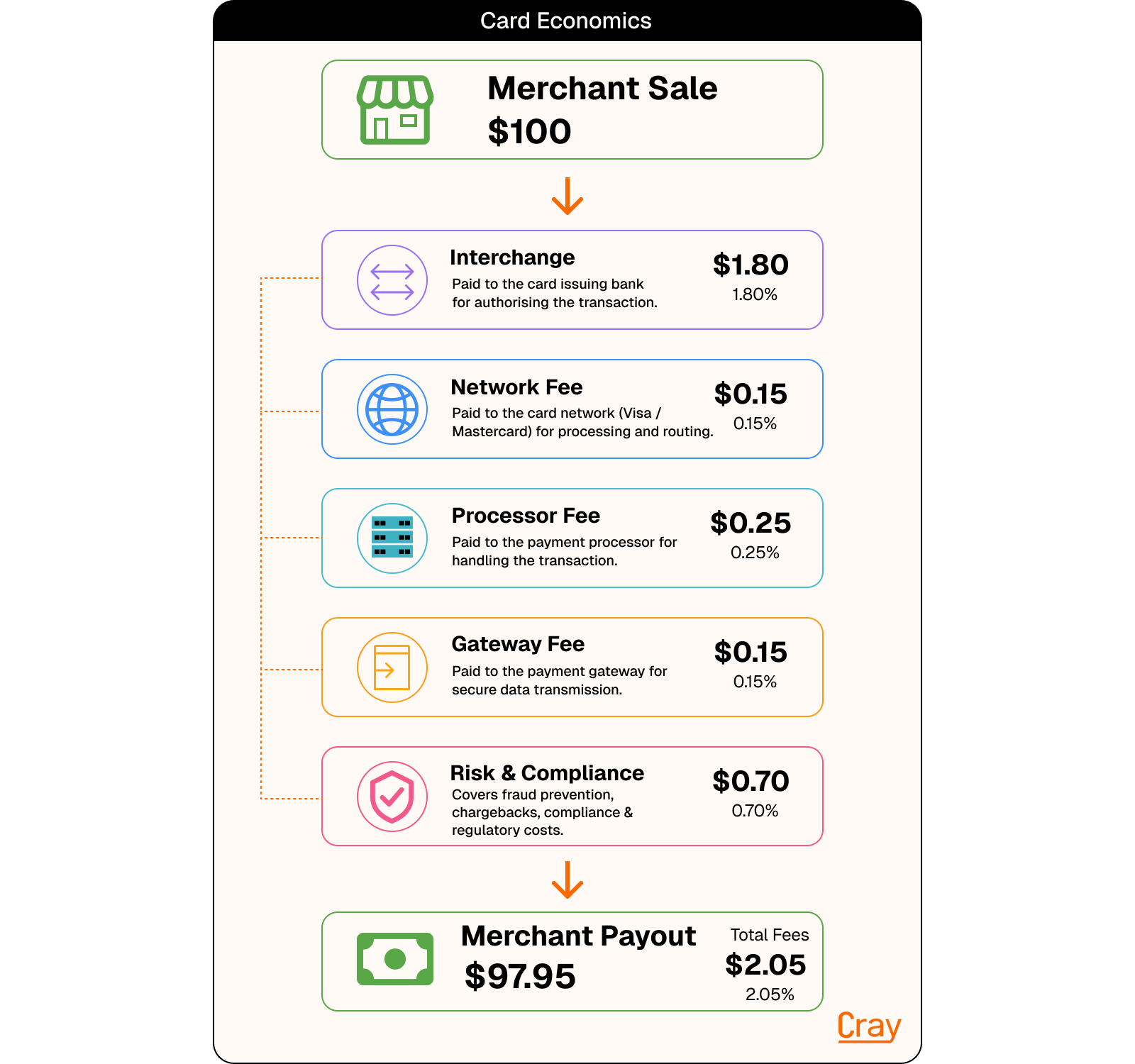
All these participants’ costs are bundled together as the merchant discount rate (MDR), typically ranging from 2-3% of every transaction to 5-6% for international payments.
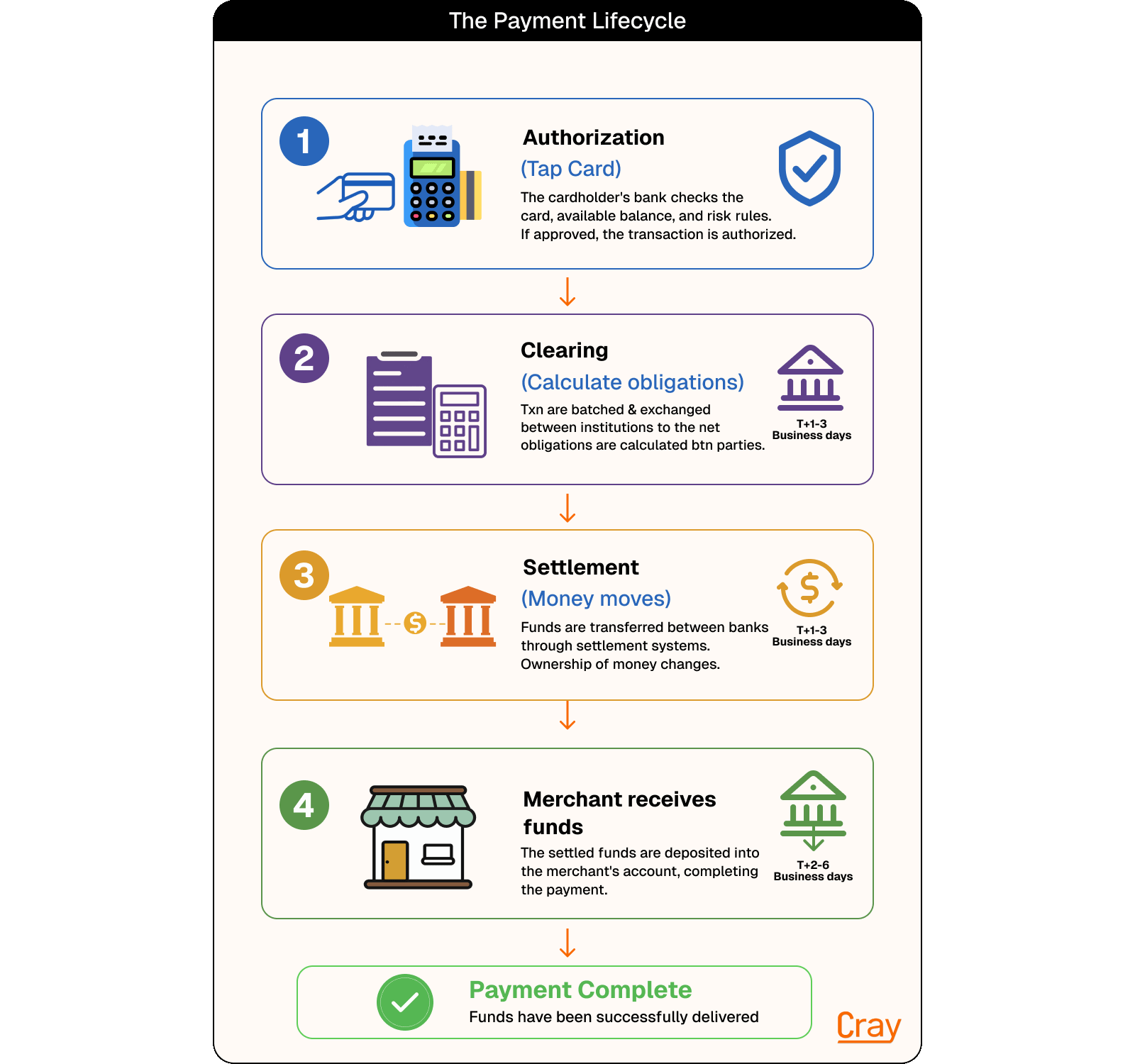
Though customers receive confirmation immediately, clearing and settlement happen later, so merchants have to wait 1-3 business days to receive funds after a successful transaction.
Merchants are actually paying for more than just moving money. Merchants are paying for credit provided by issuing banks, consumer rewards such as cashbacks and points, a fraud prevention system, and a chargeback system. These features make card payments convenient and secure for cardholders, but cost 2-3% to merchants.
What happens when a business sends a bank transfer?
Bank transfers move money directly between bank accounts. And generally involves fewer intermediaries than card payments.
They work well for payload, supplier payments, and large transactions, but were not designed for merchant checkout.
Traditional payment systems were built for a different era. Card networks optimised for consumer convenience. Bank rails optimised for institutional money movement. Both became enormously successful, but neither was designed for direct, instant, global merchant settlement.
On the other hand, modern companies and systems such as PayPal, Square, UPI, PIX, Alipay, and M-Pesa transformed how people interact with money. Sending and receiving payments feel instant from a user’s perspective, even though most transactions rely on traditional banking and card infrastructure underneath.
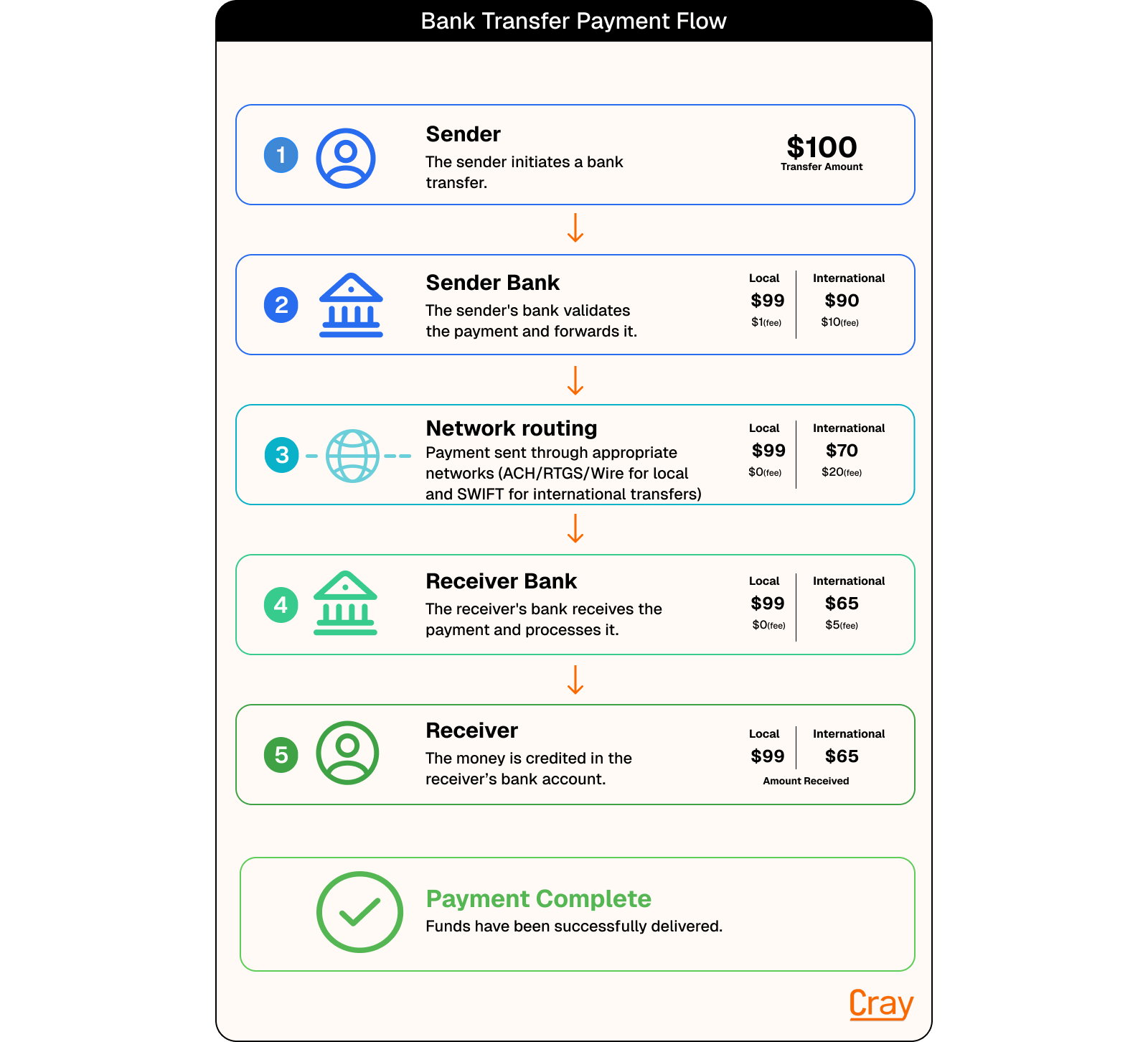
So, merchants face the tradeoff. They can accept card payments and pay higher fees for a better checkout experience, or use bank transfers and sacrifice speed, convenience, and global reach.
This gap created the opportunity for a new type of payment rail.
Why does this create a space for stablecoin payments?
The emergence of stablecoins questioned the core assumption of modern payments.
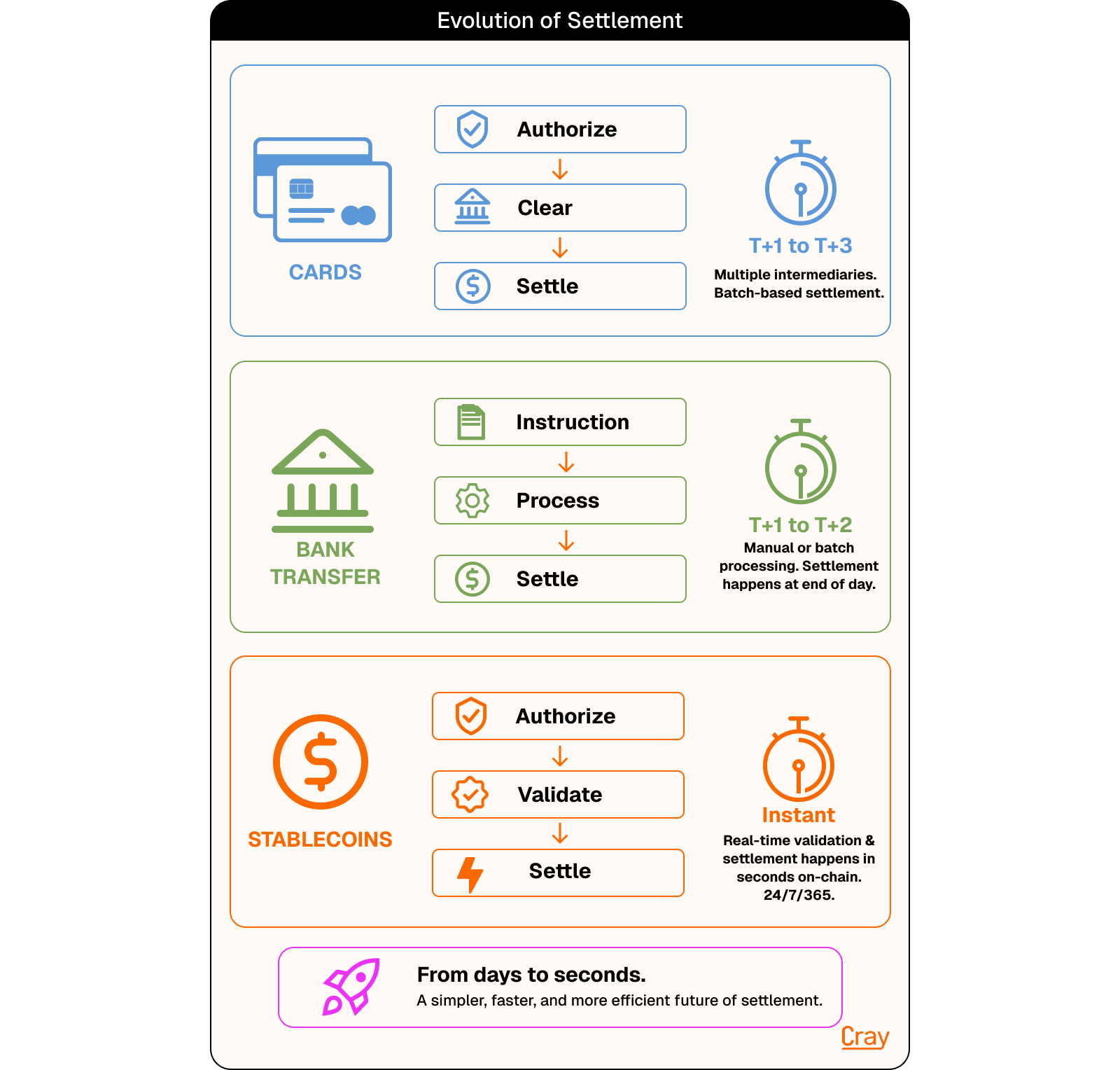
Instead of sending payment instructions through a chain of institutions, stablecoins move directly between digital wallets over blockchain networks. Settlement happens on a shared ledger instantly instead of having to wait days. The movement and settlement of money happen in the same process.
A merchant in Dubai, a customer in Brazil, and a supplier in Vietnam can transact on the same payment rail without requiring separate domestic payment systems to connect them.
For the first time, it has become possible to combine the convenience of modern digital payments with direct, instant, internet-native settlement.
This is why there’s so much attention around stablecoins. The opportunity is not simply to make payments faster or cheaper. It is to redesign how value moves across the internet.
Custodial vs Non-Custodial: The Fundamental Divide
Most stablecoin payment companies are trying to solve the same problem: help businesses accept, hold, and move digital dollars. The biggest difference between them is not the stablecoins they support or the blockchain they use. It is in who controls the funds.
In the custodial model, a third party holds funds on behalf of users (similar to a bank). The provider manages wallets, security, recovery, compliance, and settlement. It offers convenience and simplicity, which is why most payment products start here. The tradeoff is that merchants ultimately depend on the provider to access and move their funds.
In a non-custodial model, you fully own and control your wallet and funds. The payment providers give the software needed to interact with the blockchain network without touching any of your assets.
Historically, convenience has favoured custodial systems, while ownership has favoured non-custodial systems. Recent innovation in stablecoin payments is focused on narrowing this gap. Embedded wallets, MPC, delegated permissions, and managed recovery systems are making non-custodial products easier to use without giving up direct control of funds.
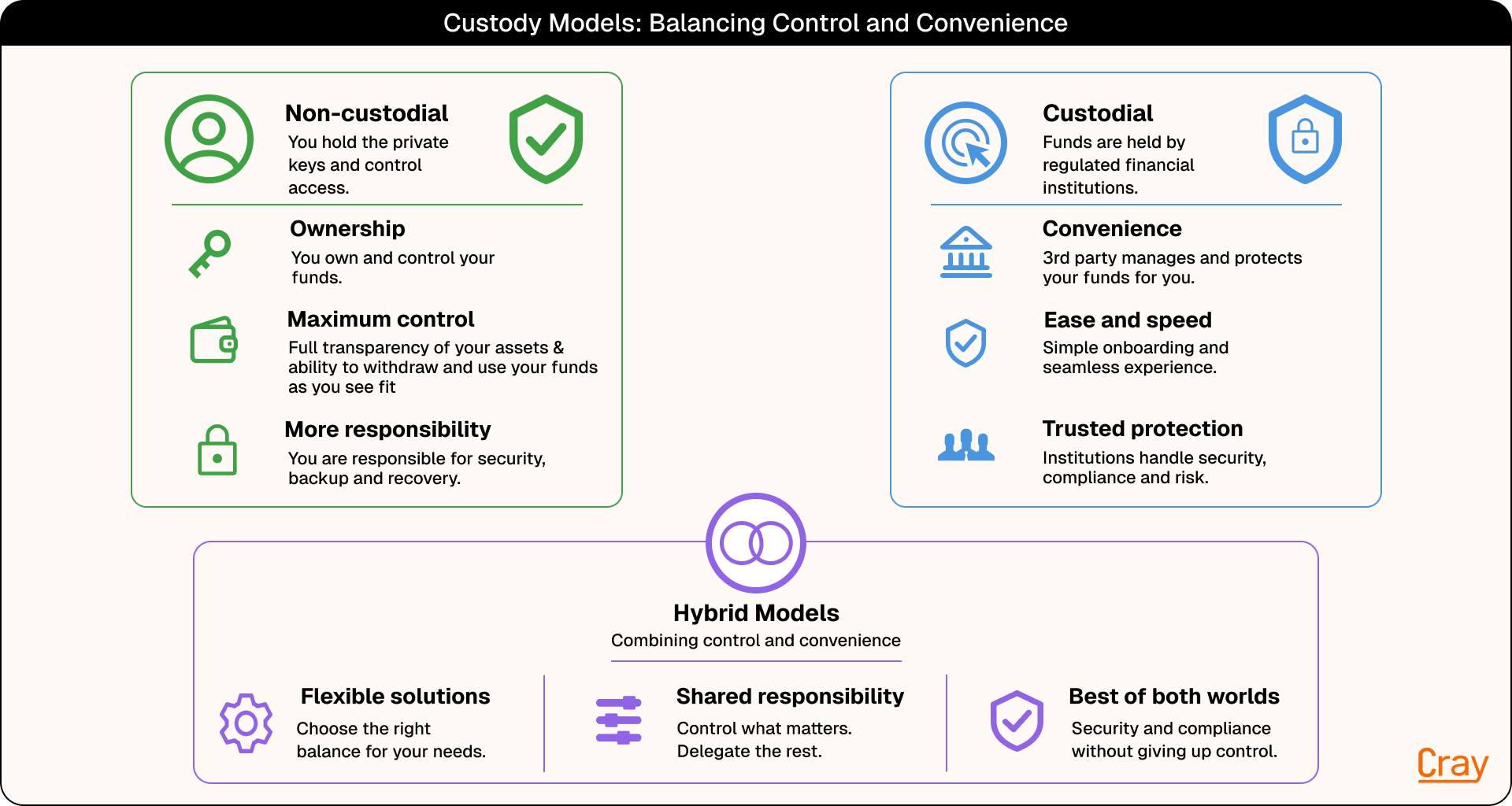
As a result, many companies are adopting hybrid approaches that combine elements of both models. Rather than choosing between convenience and ownership, they attempt to balance the two.
This direction matters because traditional payment systems are almost entirely custodial. Banks and payment providers hold money on behalf of users. Stablecoins introduce a new possibility: separating payment software from custody itself.
Cray is built around a non-custodial model. Merchants control their funds while Cray provides the infrastructure needed to accept payments, manage operations, and interact with stablecoin networks. The goal is to deliver the simplicity merchants expect from modern payment software without requiring them to give up ownership of their money.
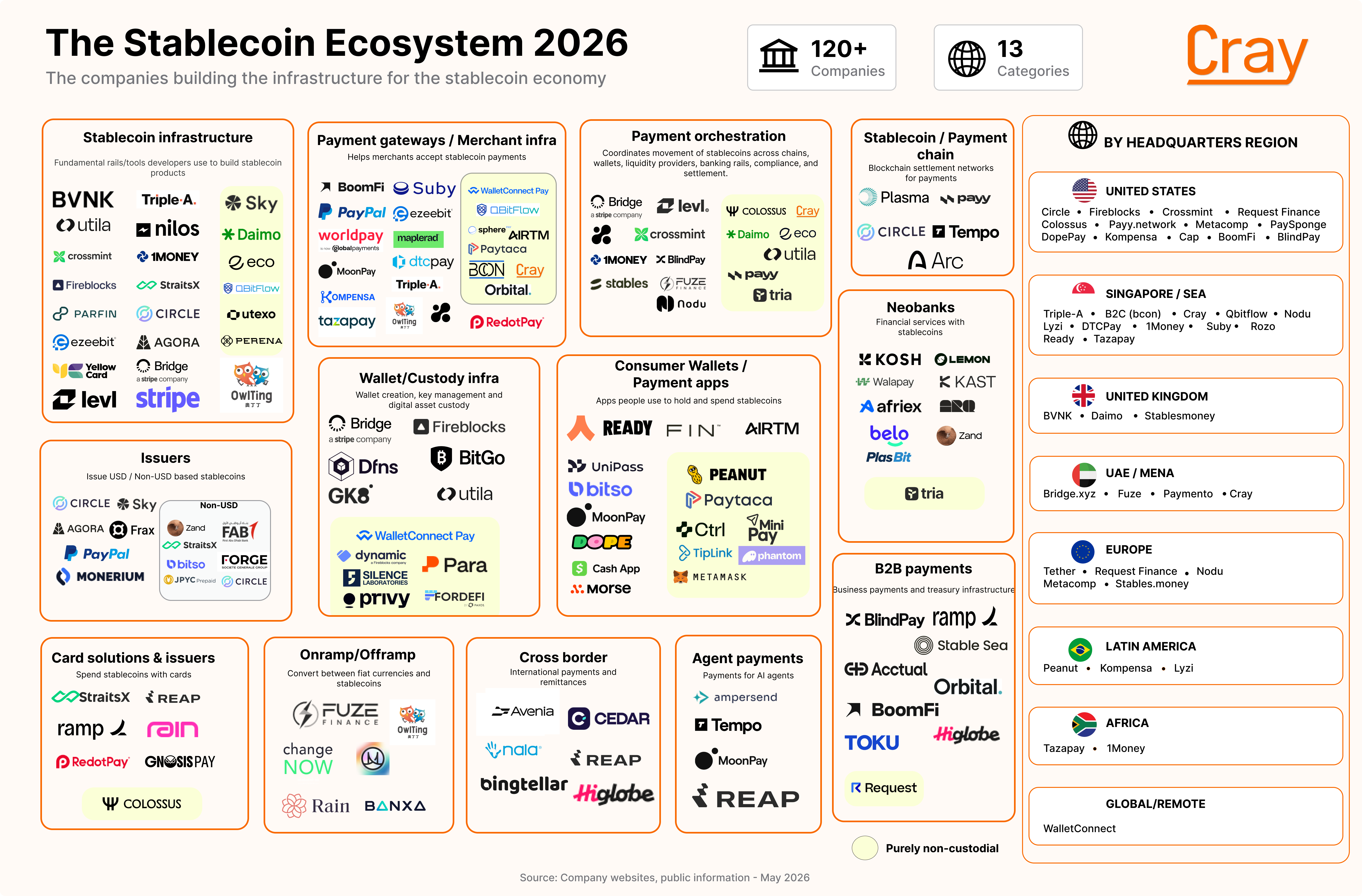
The Stablecoin Payment Map 2026- Backend Infrastructure
The entire ecosystem is being rebuilt around stablecoins, similar to how traditional payments are built around banks, card networks, processors and gateways.
At the foundation are stablecoin issuers such as Circle, Tether, Paypal, Sky etc. They create and manage digital assets such as USDC, USDT, etc. that move across blockchain networks.
Users still need ways to convert between local currencies and currencies on blockchain networks, which is where on/off-ramp providers such as Rain.com etc. come into the picture.
As payments expand across multiple networks, wallets and jurisdictions, infrastructure providers help businesses manage wallets, liquidity, routing, compliance, and settlements across different blockchain networks.
Companies like BVNK, Triple-A, Coinbase Commerce, and Cray sit on top of this, building payment and merchant infrastructure. They help businesses accept stablecoin payments and manage settlements, integrating stablecoins into real-world commerce. Think of these as functions that acquirers historically provided in card networks, helping businesses accept payments, but now on top of blockchain rails.
Stablecoin card providers such as rain.xyz and Redotpay bridge stablecoins into existing card networks, allowing users to spend stablecoins anywhere traditional cards are accepted. There are also other projects like ColossusPay that are pushing towards more direct, on-chain payment experiences.
Wallet and custody infrastructure providers such as Fireblocks, Bitgo, Privy, etc., help businesses securely manage wallets, private keys and recovery mechanisms with a custodial or non-custodial approach.
Fiat connectivity and stablecoin banking providers help businesses operating in the space get access to local banking networks, enabling treasury management, payouts, and payroll.
Taken together, these are the foundations of a new financial stack. Different companies are approaching the problem from different angles, but the direction is clear - Infrastructure is being built around stablecoin-native settlement.
The Stablecoin Payment Map 2026 - Application Layer
Infrastructure is a solid foundation but the Internet needs browsers, search engines, and apps to become useful in everyday life. Stablecoins are on the same path. Over the past few years, infrastructure has been built around stablecoins, and now a new generation of apps is being built on top of it.
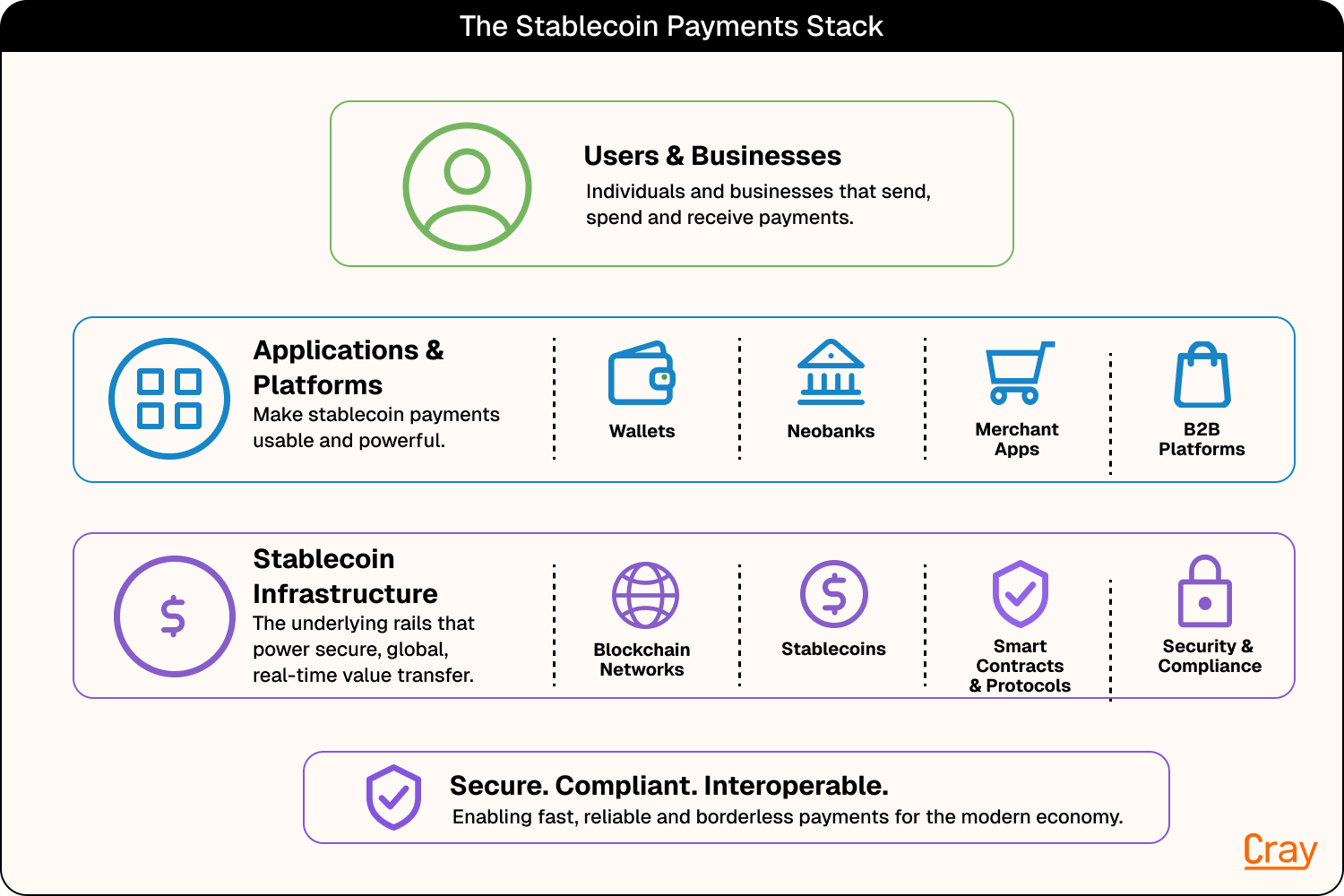
Most users don’t directly interact with stablecoin issuers, custodians, or payment processors. They interact with apps that hide all the infra complexity and make blockchain-based payments feel familiar.
Early consumer wallets such as Metamask and Phantom were largely for the early crypto audience, traders, and degens, who were comfortable with managing wallets, networks, and private keys. But as we scale to a larger retail audience, a newer generation of products like MiniPay, peanuts, and Cray make it easier for mainstream people to hold and transact crypto.
Another category is focused on financial services. Stablecoin-powered neobanks such as Lemon and KAST are building banking experience with blockchain settlements. Users can hold balances, move money internationally, spend through cards, and use financial services without needing to understand wallets, networks, or stablecoins.
There’s a growing demand for stablecoins in cross-border payments and B2B commerce, with companies like Request Finance helping businesses move money between suppliers, contractors and employees globally.
For many users, especially in regions with unstable currencies or expensive remittance systems, these products provide an alternate way to access digital dollars and global financial networks.
On the retail side, companies like Cray and Triple-A are building merchant payment applications, helping businesses accept stablecoin payments and integrate them into day-to-day operations. The goal is similar to what Square did for SMB card acceptance: hide the underlying complexity and make payments feel familiar to both businesses and customers.
Another emerging category is Agentic Payments. Stablecoins are not only used by people and businesses but increasingly by software itself. These AI agents need to pay for API, services, computation, or data, and crypto is the only way they can truly own the money. And stablecoins offer reliable internet-native payments.
While users and agents interact with apps, the infrastructure operates underneath. What started as infrastructure for moving digital dollars is becoming infrastructure for the real-world economy. Stablecoins are shifting from a technology story to a payments story.
Rise of Non-USD Stablecoins
People may trade in dollars, but they earn, save, spend, pay suppliers and taxes in local currencies. Stablecoins today are heavily dollar-dominated, but as they move beyond trading and into everyday commerce, a purely dollar-based ecosystem creates dependency and friction.
Stablecoins started as digital dollars because the dollar dominates international trade and finance. As stablecoins become payment infrastructure rather than just trading assets, demand naturally emerges for local currencies on the same rail.
Governments, banks, and financial institutions are increasingly exploring local-currency stablecoins to participate in the new generation of payment infrastructure and make adoption easier for businesses.
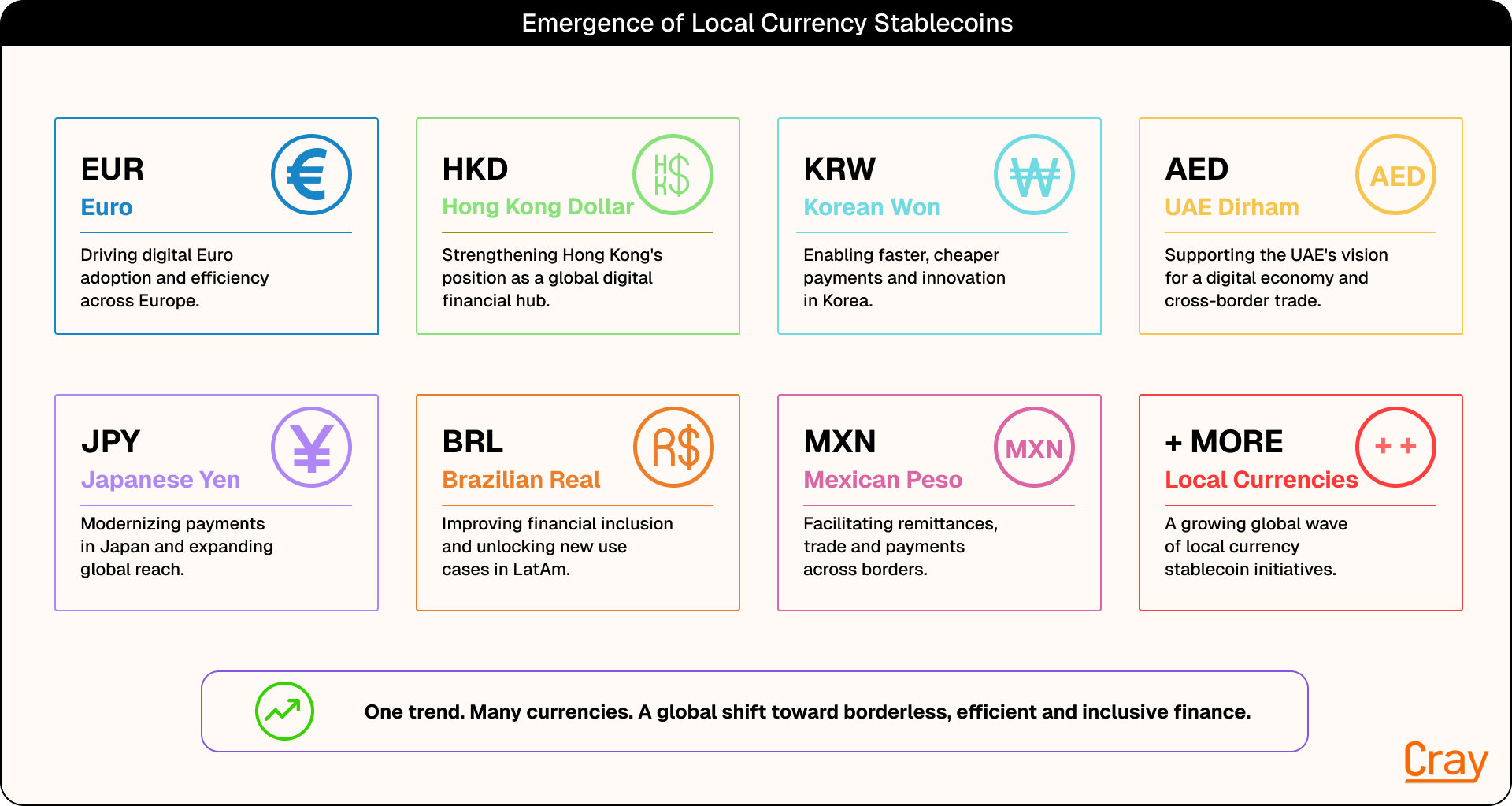
The long-term opportunity is creating a settlement layer where different currencies can move on the same infrastructure worldwide. Just as the internet standardised how information moves regardless of language or geography, stablecoins create the possibility for currencies to operate on a common settlement layer.
Governments and regulators are watching closely as stablecoins become increasingly relevant to payments and financial institutions. What was once viewed primarily as a crypto asset is becoming a significant piece of the financial system itself.
Regulation Clarity
Regulation was the biggest reason crypto payments remained niche. That is beginning to change.
Around the world, governments have stopped asking why stablecoins should exist and are thinking about how stablecoins should be regulated.
Conversations are moving from prohibition to frameworks. Major jurisdictions such as the US (GENIUS Act), EU (MiCA), UAE (VARA), Singapore, and Hong Kong are establishing clear rules for stablecoins and digital payments.
This clarity gives banks, merchants, payment providers, and consumers confidence and encourages more infrastructure, more products and more adoption.
Blockchain-based settlements are not tightly coupled with identity. When someone taps a card, the issuing bank has already verified the customer and performed necessary compliance checks. With blockchain transactions, money moves between wallets without necessarily an identity being attached to the wallet or to every transaction.
While this has its own benefits, such as an open, transparent, interoperable system, it also introduces new compliance responsibilities for businesses accepting payments. The onus is on the provider to ensure funds are being sent and received by legitimate people and are not linked to any suspicious illegal activity.
So, to make stablecoin payments mainstream in real-world commerce, providers need checks in place to ensure money is sent and received safely, compliantly and by verified parties. This is why many teams are focused not only on moving money efficiently, but also on building the compliance and trust layers required for mainstream adoption.
Technology exists, and infrastructure is being built. Adoption is growing. Regulations are becoming clear. Now the question is not if stablecoins payments can work, but what happens if these trends continue.
The Future: Same-cost, Instant, Worldwide
For centuries, the cost and complexity of moving money increased with distance. Different countries built different payment systems, banks established correspondent relationships, and businesses accepted delays, foreign exchange costs, and settlement risk as part of global commerce.
Stablecoins introduced a different possibility. A payment across the street and across the world can settle on the same infrastructure, instantly with little to no risk. The underlying settlement process doesn’t become more complex because money crosses a border.
If this trend continues, businesses may no longer need separate systems for domestic payments, international payments, supplier settlements, treasury movements and global commerce. The same infrastructure could be used to move money anywhere in the world.
For the first time, the technology, infrastructure, adoption and regulatory momentum are moving in the same direction towards stablecoins becoming a global financial ecosystem.
Conclusion & Call to Action
An entire financial ecosystem is being built around stablecoin issuers, banks, custody providers, payment infrastructure, merchant applications, compliance systems and new financial products.
Looking at the market today, a familiar pattern emerges. Stablecoins first gained adoption through trading, then expanded into transfers, remittances and treasury management. Merchant payments remain one of the last major layers still being built.
That is where we believe the opportunity lies.
At Cray, our focus is simple: make stablecoin payments easy to accept for merchants, similar to digital payments, so that they can leverage the growing stablecoin economy.
The transition is happening slowly and will continue. Existing systems remain deeply integrated in the global economy and will continue to serve billions. But one thing is clear: stablecoins have established themselves as a credible alternative settlement layer.
The stablecoin payment infrastructure is being built, adoption is accelerating, and the rules are becoming clearer. The next decade will determine which products and approaches succeed.
We would like to thank Joel John, Founder of Decentralised.co, for taking the time to review this report and provide his valuable inputs.
References
This article is based on publicly available research, official documentation, company websites, and independent analysis.
https://dune.com/stablecoin-report
https://bvnk.com/utility
https://www.jpmorgan.com/payments/payments-unbound/magazine/articles/visual-timeline-payment-rails
https://www.visa.com/en-us/thought-leadership/innovation/evolution-of-payments-25-year-retrospective
https://media-publications.bcg.com/Stablecoins-five-killer-tests-to-gauge-their-potential.pdf
https://www.bloomberg.com/news/articles/2026-01-08/stablecoin-transactions-rose-to-record-33-trillion-led-by-usdc
https://www.circle.com/reports/state-of-the-usdc-economy