


I recently had to pay $1000 internationally for a design gig. After adding the beneficiary’s account, I waited three hours for activation. The next day, I initiated the SWIFT transfer, carefully verifying exchange rates before confirming. Yet, when the payment finally arrived, the recipient received about $70 less than intended, despite the transaction fees I'd already paid.
Imagine expecting a fair payment for your work and receiving significantly less through no fault of your own. When I reached out to my bank, all they said was, “The correct fees were applied.” That's all, leaving me stuck. I didn't have the time or energy to track down missing money or spend hours on customer support calls, without even the assurance of a refund?
Sadly, experiences like mine are far too common despite the existence of a viable solution. stablecoins offer a clear solution: instant international transfers, negligible fees, and total transparency. These aren't just theoretical promises – they're quietly reshaping global finance. Beyond simplifying international payments, stablecoins offer genuine financial freedom by acting as a global currency–unrestricted by geographical limitations or boundaries. They empower everyday people with instant access to decentralised finance and the diverse opportunities it unlocks, from savings and investments to lending and beyond. Stablecoins have already surpassed traditional payment networks in transaction volume, quietly reshaping how ordinary people around the world manage, move, and grow their money.
Tracking the Current Financial Landscape: Notable Expansion or Scope for Growth?
The numbers clearly speak for themselves. Stablecoins now process around $35 trillion in annual transaction volume. To put this in perspective, Visa handles about $15.7 trillion annually, while Mastercard processed around $9 trillion in just Q4 of 2024.
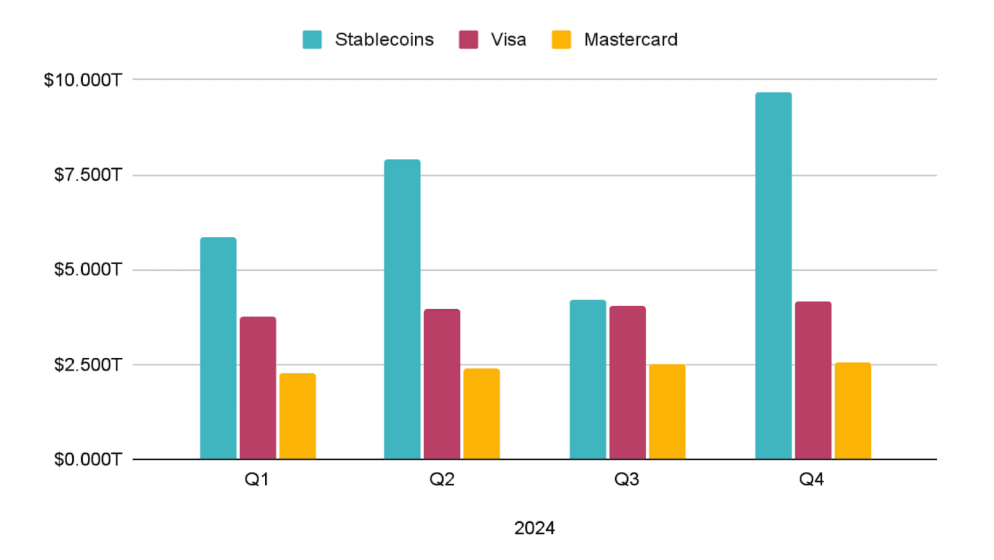
Yet, despite handling such massive transaction volumes, stablecoins remain surprisingly underutilized compared to traditional currencies. Their usage is still largely concentrated in trading and cross-border payments rather than everyday spending, commerce, or salaries.
For example, they’re rarely accepted at physical point-of-sale or integrated into payroll systems, despite dominating on-chain transfers.
The total stablecoin supply stands at about $214 billion–roughly 100X smaller than the U.S. money supply alone, which is approximately $18.4 trillion as of Jan 2025. The eurozone is next, with a money supply of €10.6 trillion. Compared to the traditional foreign exchange market, where daily OTC forex transactions average around $1.1 trillion, stablecoins still have enormous room to grow.
Tom Vieira, Head of Product at Base, captures the essence of why stablecoins matter today:
“Stablecoins offer clear benefits over traditional finance. Crypto runs 24/7, transactions typically cost less than a cent, and international payments settle instantly instead of taking days and costing over $50.”
Stablecoins aren’t waiting for the future–they’re redefining it right now. Their rapid rise highlights an ongoing shift toward a more efficient, transparent, and accessible global financial system.
Infrastructure Shapes Adoption–Where Stablecoins Actually Flow
Now that we’ve looked at the demand side, let’s shift focus to adoption. Stablecoin adoption depends heavily on where the right infrastructure exists and where transactions are fast, cheap, and effortless.
Ethereum has long been the home base for stablecoins, with most of the supply and volume historically concentrated there. But in recent years, other blockchains have gained serious traction by offering better speed, lower fees, and easier user experience.
TRON, for example, has become a dominant player in USDT activity, especially in emerging markets. It processes billions in daily volume–driven not by hype but by real-world utility. In many countries, USDT on TRON functions like digital cash, offering a reliable and accessible tool for saving and everyday payments.
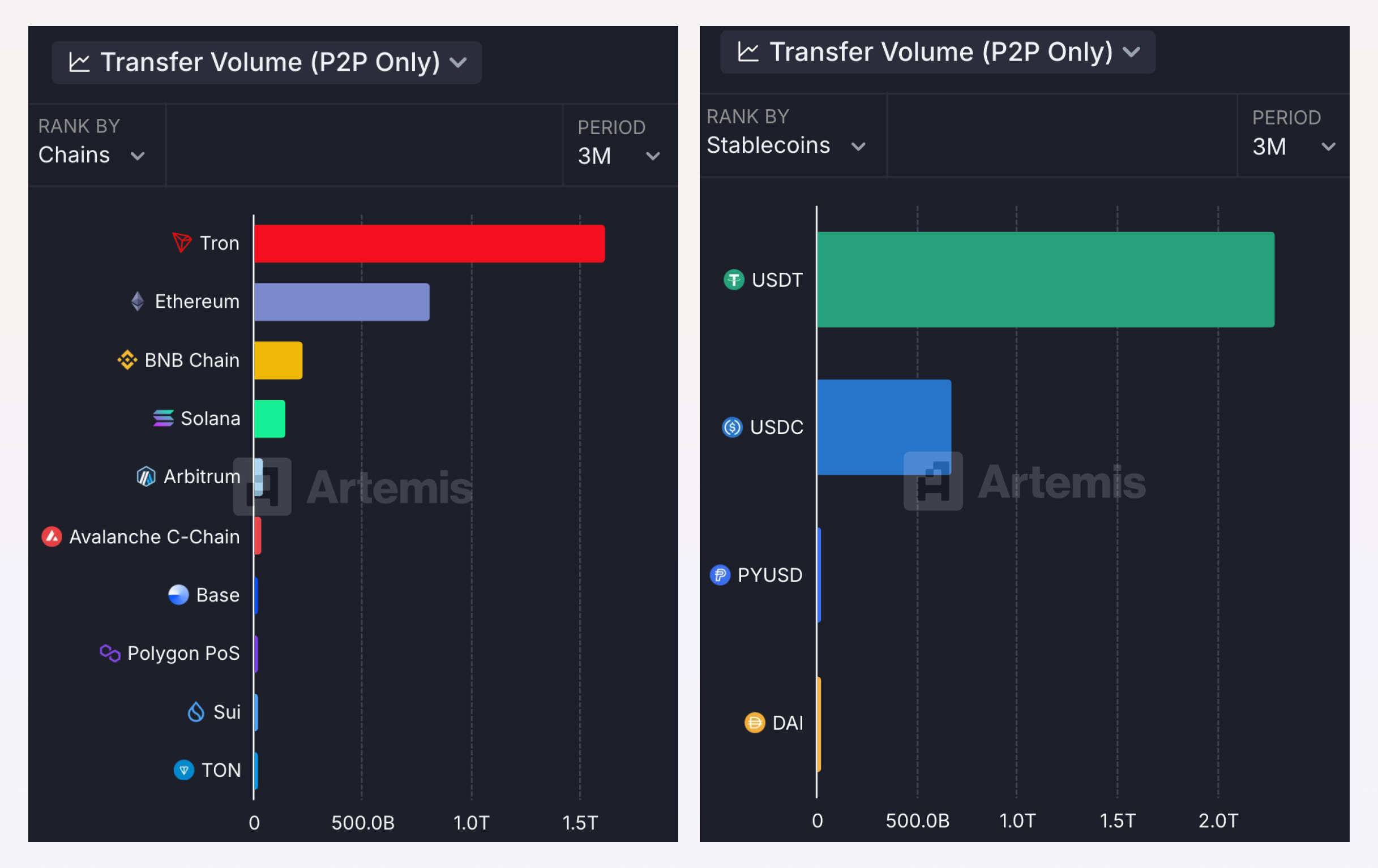
Solana has also gained traction, particularly among traders. With ultra-low fees and fast confirmations, it’s become the go-to chain for high-frequency use cases like memecoin trading–where liquidity and instant execution matter most.
“Stablecoins tend to flow where the infrastructure is right—fast and cheap transactions—and where the use cases demand them.” — Andrew Hong, Founder at Herd
People don’t care about which blockchain they’re using. They care that it works. The chains that make stablecoins simple, cheap, and usable are the ones that are rapidly gaining adoption.
From Binance to Hyperliquid—Stablecoins Are Powering It All
While most conversations around stablecoins focused on blockchains, a large part of their activity today happens on centralised platforms. Crypto exchanges, especially centralised ones like Binance, Bitget, and Coinbase, act as major hubs for stablecoin flow.
These platforms hold massive reserves of USDT, USDC, and other stablecoins, powering trading, settlements, and cross-border transfers. Their seamless interfaces and global liquidity make them the first stop for millions of users looking to enter or exit crypto markets, especially in geographies where access to traditional banking is limited.
But the momentum isn’t just limited to centralised exchanges. Decentralised exchanges built directly on-chain are seeing explosive growth too. Platforms like Hyperliquid are offering interfaces that rival CEXs without compromising on control and transparency.
This dual moment across CEXs and DEXs shows how stablecoins are no longer confined to DeFi insiders or crypto native users. They’re becoming the backbone of practical, everyday crypto usage across platforms, both centralised and decentralised.
Stablecoins have emerged with impressive virality and utility and are no longer just crypto curiosity!
Stablecoins: From Utility to Opportunity
What People want from stablecoins is changing. It’s no longer just about transferring dollars. It's about how those dollars can move, earn, and stay safe.
New stablecoin models are starting to offer more than just price stability. Yield-bearing stablecoins, like USDe from Ethena, are designed to generate returns while maintaining a dollar peg. This introduces a new use case: stablecoin as an income-generating asset. Instead of simply holding the value, they can now play an active role in how users manage and grow capital on-chain.
Platforms like Pendle are building on top of this momentum, enabling users to tokenize and trade future yield, unlock fixed income strategies, or hedge positions, all using stable assets. These kinda tools were previously limited to traditional finance or high-risk crypto instruments. Now, stablecoins are becoming the foundation for more accessible, programmable, and composable financial strategies.
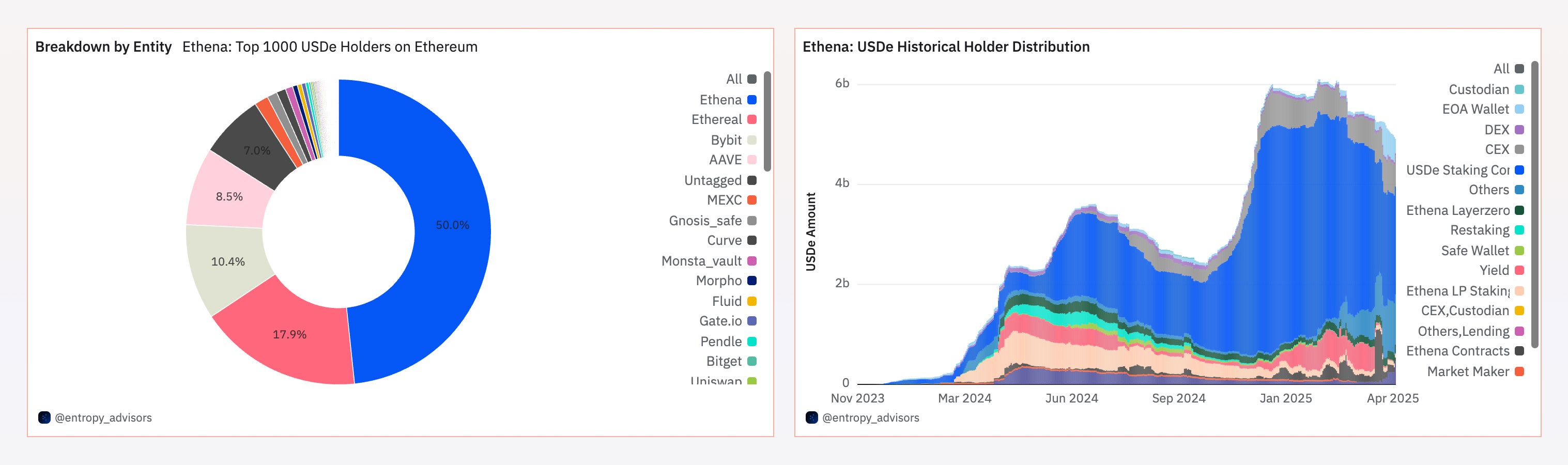
But adoption isn’t limited to DeFi. It’s also seeing active movement on centralised exchanges.
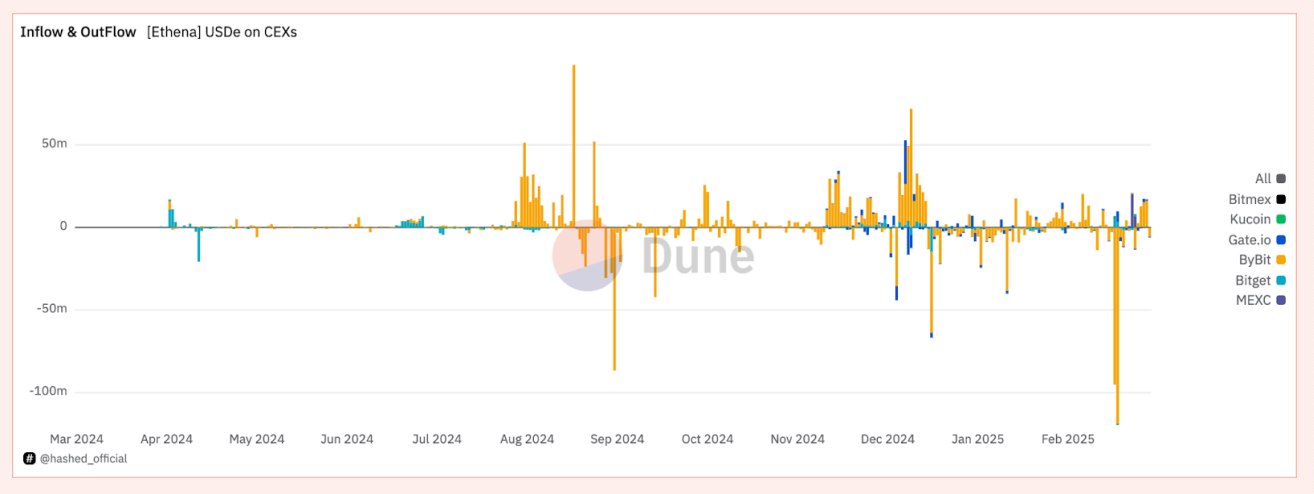
This kinda activity highlights the growing expectations around what stablecoins can do—not just hold value but handle volatility, generate yield, and stay accessible under pressure.
As Conor Ryder from Ethena Labs puts it,
“The next generation of stablecoins must be resilient in all market conditions.”
We are seeing different designs emerge for different needs. Some are built for fast payments, others for regulatory clarity, and now a growing class is being designed for opportunity. As this layer matures, stablecoins are beginning to look less like digital cash and more like the infrastructure for how people interact with money online.
The Future Is Already in Motion
Stablecoins started as a simple idea: bring the dollar on-chain. But their role today is anything but simple. They’ve outpaced traditional payment networks in volume, become essential tools for users across centralised and decentralised platforms, and are now evolving into programmable financial instruments.
Whether it's sending money across borders, protecting savings in unstable economies, or unlocking new forms of yield, stablecoins are quietly reshaping how value moves in the modern world.
This isn’t a theoretical future. It’s already happening, and it’s moving fast.
If you’re building something around stablecoins — infra, UX, flows, or something new — I’d love to hear from you.
Written with Parag